As Edge AI continues to evolve at an unprecedented pace, every leap in compute capability places higher demands on the underlying hardware platform. With the introduction of NVIDIA Jetson T5000 (Jetson Thor), embedded computing officially enters the Blackwell architecture era.
Designed and manufactured in Germany, the Auvidea X242 industrial-grade carrier board stands out as a purpose-built foundation for this flagship AI module, offering forward-looking support for PCIe Gen 5 and dual 10GbE networking—features that define the next generation of high-performance edge systems.

1. Peak Compute Performance: When Blackwell Meets Industrial-Grade Design
The Auvidea X242 is not a generic development board. It is a production-ready, industrial carrier board specifically engineered for the Jetson T5000, combining cutting-edge compute architecture with long-term stability and robustness required in commercial deployments.
Key characteristics of the Jetson T5000 platform include:
- Blackwell-architecture GPU with 2,560 CUDA cores, delivering up to 2,070 TFLOPS of AI performance under FP4 sparse workloads.
- 14-core Arm Neoverse-V3AE CPU, optimized for automotive-grade and industrial real-time processing.
- 128 GB LPDDR5X memory on a 256-bit interface, providing up to 273 GB/s of memory bandwidth—ensuring smooth execution of large language models (LLMs) and complex computer vision pipelines directly at the edge.
Together, the X242 and T5000 form a tightly integrated solution that bridges extreme AI performance with industrial reliability.
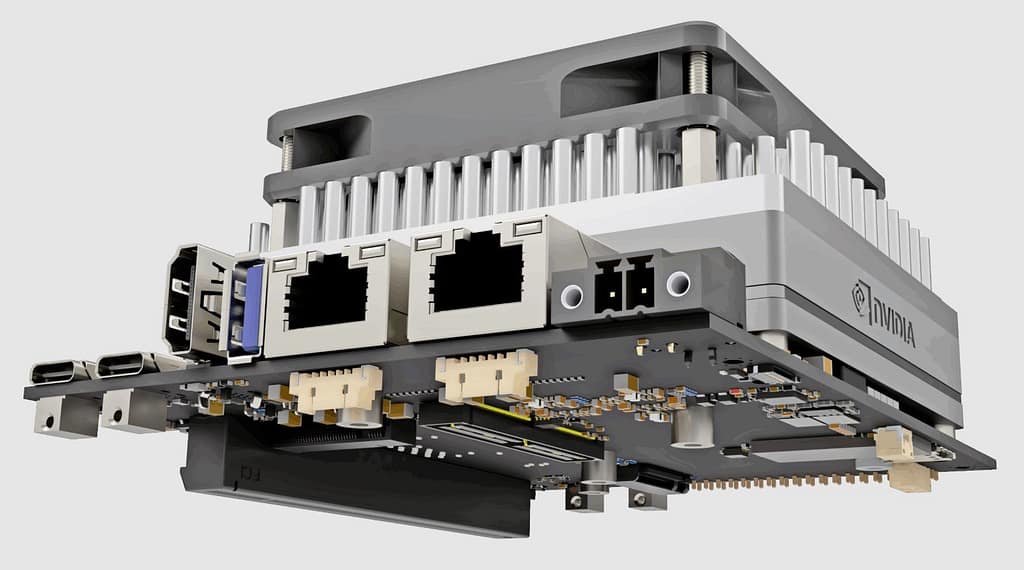
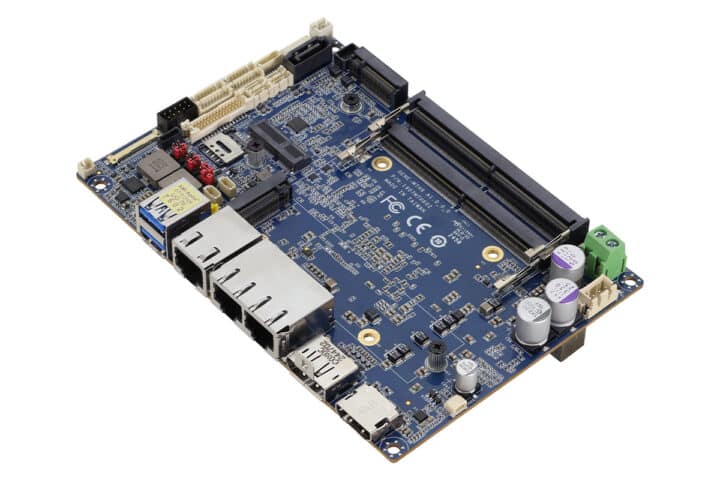
AUVIDEA X242 Front View
2. Core I/O Innovations: Breaking the Data Throughput Barrier
The defining strength of the Auvidea X242 lies in its exceptional I/O capabilities, which are critical for high-performance embedded AI systems.
2.1 PCIe Gen 5: Ready for the Next Expansion Wave
One of the few carrier boards on the market with native PCIe Gen 5 support, the X242 delivers 32 Gbit/s per lane of bandwidth. In Revision 3, the onboard PCIe x16 slot operates at PCIe Gen 5 x8, enabling full-speed connectivity for high-end capture cards, AI accelerators, or custom FPGA-based expansion modules.
This architecture ensures long-term scalability as next-generation peripherals emerge.
2.2 Dual 10GbE: A Foundation for Sensor-Rich Systems
The board integrates two 10GbE RJ-45 Ethernet ports, powered by the Realtek RTL8127 controller. This eliminates the need for external network expansion cards and provides sufficient throughput for multiple simultaneous 4K video streams—ideal for autonomous systems, smart city gateways, and multi-sensor fusion workloads where latency and bandwidth are critical.

3. Application-Oriented Design: Setting New Industry Benchmarks
3.1 Embodied AI and Precision Robotics
In robotics and embodied intelligence systems, real-time perception and deterministic control are essential. The X242 delivers comprehensive support across the entire processing chain:
- Vision pipeline: A 16-lane MIPI CSI-2 interface enables connection of multi-camera sensor arrays. Combined with the Jetson T5000’s PVA v3 vision accelerator, the system achieves sub-millisecond visual processing for obstacle avoidance and spatial awareness.
- Industrial control interfaces: An onboard CAN bus transceiver, along with multiple UART ports, allows direct communication with industrial motors, actuators, and control networks.
- Multi-display support: One HDMI output and three USB-C ports supporting DisplayPort Alt Mode enable flexible integration of advanced HMI and visualization interfaces.
3.2 High-Speed Edge Storage and Data Preprocessing
For AI gateways and data-intensive edge nodes, storage performance is a decisive factor:
- PCIe Gen 5 NVMe support: The M.2 Key M slot, operating over a PCIe Gen 5 x2 link, enables next-generation NVMe SSDs with extremely high write throughput—well suited for real-time local storage and indexing of 8K surveillance video or raw sensor data.
- 5G and wireless integration: An M.2 Key B slot supports 5G cellular modules, while onboard Wi-Fi 6 capability provides high-speed wireless connectivity. Together, they form a seamless high-bandwidth bridge from edge devices to cloud infrastructure.

4. Key Specifications Overview
| Category | Specification | Core Value |
|---|---|---|
| Processor Support | NVIDIA Jetson T5000 (Blackwell architecture) | Up to 2,070 TFLOPS AI performance |
| Storage Expansion | M.2 Key M (PCIe Gen 5 x2) | Ultra-high-speed NVMe SSD support |
| Networking | 2 × 10GbE RJ-45 + Wi-Fi 6 | 10-gigabit wired networking with high-speed wireless |
| Vision Input | 16-lane MIPI CSI-2 | Multi-camera industrial sensor compatibility |
| Power Input | Wide-range 24 V to 48 V DC | Compatible with industrial and automation power systems |
| Form Factor | 104.6 × 125 mm (X23x series compatible) | Compact design for drop-in system upgrades |
5. German Engineering and Long-Term Reliability
Designed and manufactured in Germany, the Auvidea X242 reflects a strong commitment to engineering quality, long-term availability, and professional technical support. To enhance system security and robustness, the board integrates an ATSH204A hardware encryption chip for IP protection.
The power subsystem is engineered with up to 300 W of power headroom, incorporating hot-plug capability, over-voltage protection, and reverse-polarity protection. These features ensure stable operation even in harsh industrial and automotive environments.
The combination of the Auvidea X242 and NVIDIA Jetson T5000 is more than a simple hardware pairing—it represents a redefinition of edge AI productivity. From advanced industrial automation to high-speed autonomous platforms, the X242 provides a performance foundation that is both future-proof and deployment-ready.
By aligning Blackwell-class compute power with PCIe Gen 5, dual 10GbE, and industrial-grade design, the X242 sets a new benchmark for next-generation edge AI systems.