In today’s fast-evolving AIoT landscape, developers frequently face a frustrating reality: even a simple “vision + voice” demo can require a desk full of jumper wires, breadboards, and loosely connected sensor modules. The ESP32-S3 AIoT Basic Integrated Development Kit fundamentally changes this experience.
Designed specifically for education, beginners, and rapid prototyping, this all-in-one development board integrates complex hardware into a single, well-engineered platform—dramatically reducing setup time and allowing ideas to move from concept to implementation faster than ever.
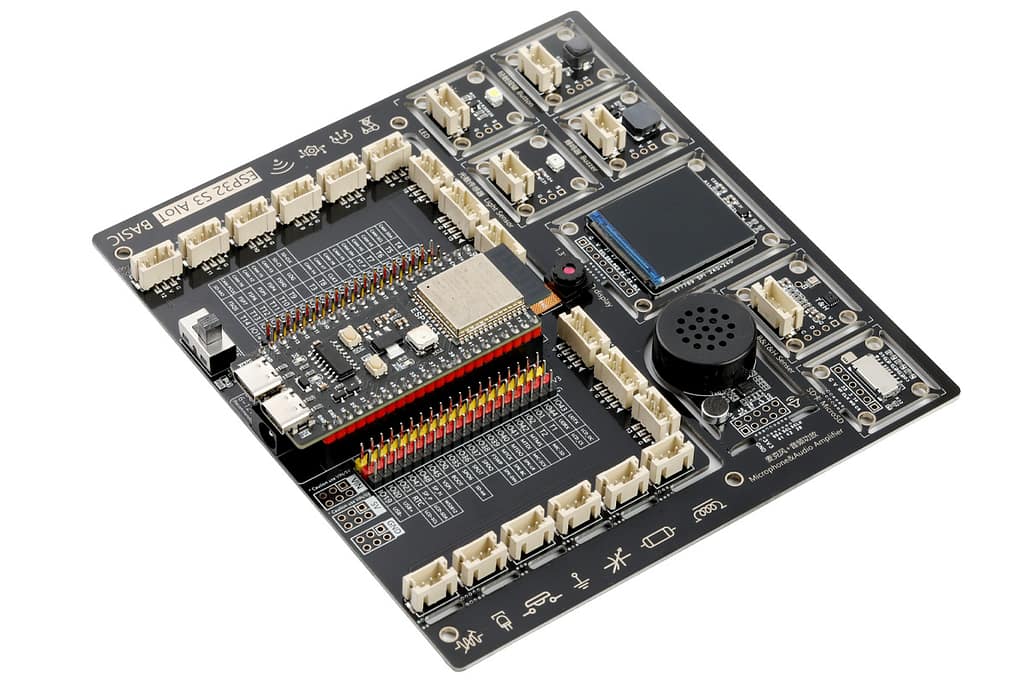
Core Performance: Dual-Core Processing with AI Acceleration
At the heart of the kit is the ESP32-S3 SoC, a processor optimized for edge AI workloads. It features a dual-core LX7 microcontroller running at up to 240 MHz, providing strong real-time performance for AI and IoT applications.
Key performance highlights include:
- AI hardware acceleration via vector instruction extensions, significantly improving efficiency for edge workloads such as face detection and keyword spotting.
- Large on-board memory, including 8 MB PSRAM and 16 MB SPI Flash, enabling smooth execution of compact neural network models and high-resolution display drivers.
- Integrated wireless connectivity, with Wi-Fi 4 and Bluetooth 5 (LE / Mesh) support, making it well suited for smart home systems and industrial remote monitoring.
Core Hardware Specifications
| Component | Specification |
|---|---|
| SoC | ESP32-S3 |
| CPU | Dual-core LX7, up to 240 MHz |
| AI Acceleration | Vector instruction extension for ML workloads |
| PSRAM | 8 MB |
| Flash | 16 MB SPI Flash |
| Wireless | Wi-Fi 4, Bluetooth 5 (LE / Mesh) |
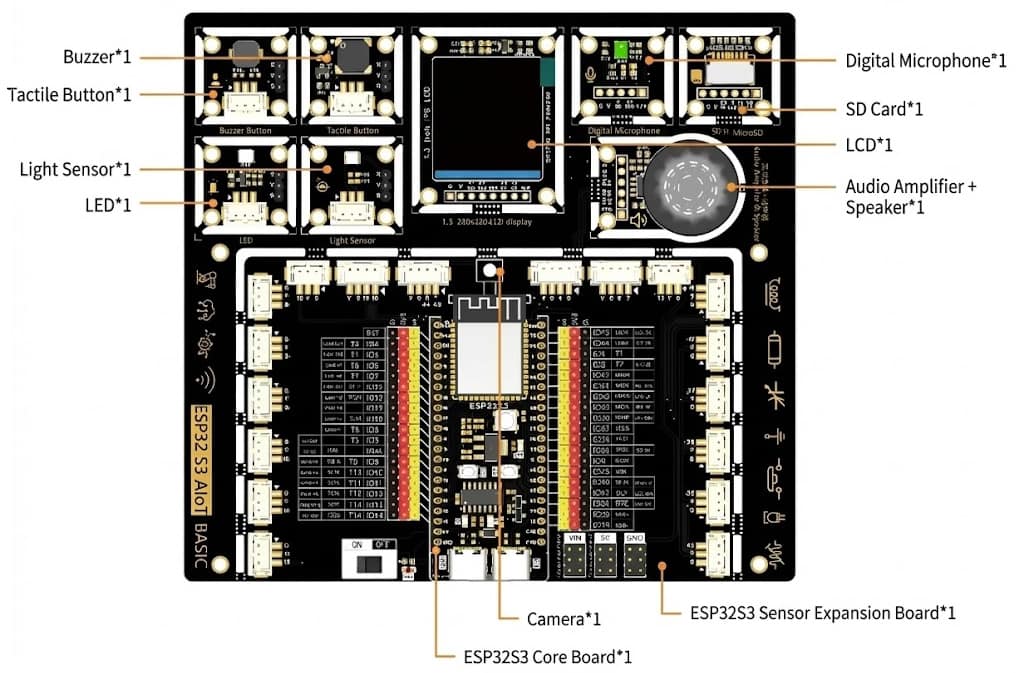
Nine Integrated Modules: Instant Access to Multisensory Capabilities
One of the most compelling features of the ESP32-S3 AIoT Basic kit is its nine pre-integrated hardware modules, all mounted directly on the PCB. This “plug-and-play” design eliminates soldering and removes the need to manually map pin connections.
Developers can immediately experiment with vision, audio, display, sensing, and storage functions straight out of the box.
Integrated Module Overview
| Module Category | Hardware Specification | Typical Use Cases |
|---|---|---|
| Visual Input | On-board camera | Face recognition, object detection, QR code scanning |
| Audio Interaction | Digital microphone + audio amplifier + speaker | Voice assistants, noise monitoring, smart announcements |
| Visual Output | 1.3-inch IPS LCD, 240 × 240 | Data visualization, UI design, image preview |
| Environmental Sensing | Light sensor + buzzer | Automatic lighting control, alert notifications |
| Storage Expansion | MicroSD card slot | Local data logging, multimedia storage |
In addition, the board provides six 18-pin GPIO headers and a Grove expansion interface, allowing easy system expansion if the integrated modules do not fully meet project requirements.
Flexible Software Development: From Visual Blocks to Low-Level Control
To accommodate developers at different skill levels, the ESP32-S3 AIoT Basic kit offers a broad and flexible software ecosystem:
- Aily Blockly (visual programming)
Ideal for education and entry-level users, enabling camera and display control through drag-and-drop logic blocks. - Arduino IDE
Leverages a vast open-source ecosystem, allowing rapid prototyping through existing libraries. - ESP-IDF framework
Provides full low-level access for professional engineers seeking maximum performance and fine-grained system control.

Why Choose the ESP32-S3 AIoT Basic Kit?
- Designed for education
A large 145 × 135 mm PCB with 3 mm mounting holes makes it easy to install on teaching stands or laboratory benches. - Fast proof-of-concept validation
With a cost around USD $29, startups and makers can quickly validate the full sense–process–communicate pipeline. - Stable and flexible power input
Supports USB-C 5V power as well as Vin input (6–12 V), leaving ample headroom for driving external high-power peripherals such as motors.
Whether you are exploring the limits of edge AI on the ESP32-S3, or searching for a durable and scalable IoT teaching platform, the ESP32-S3 AIoT Basic Integrated Development Kit stands out as a highly cost-effective solution in today’s market.
By consolidating traditionally scattered components into a cohesive hardware ecosystem, it allows developers to focus less on wiring and more on algorithm design, system logic, and application innovation.