1. Product Positioning and Core Advantages
(1) An Evolved Smart Vision Platform
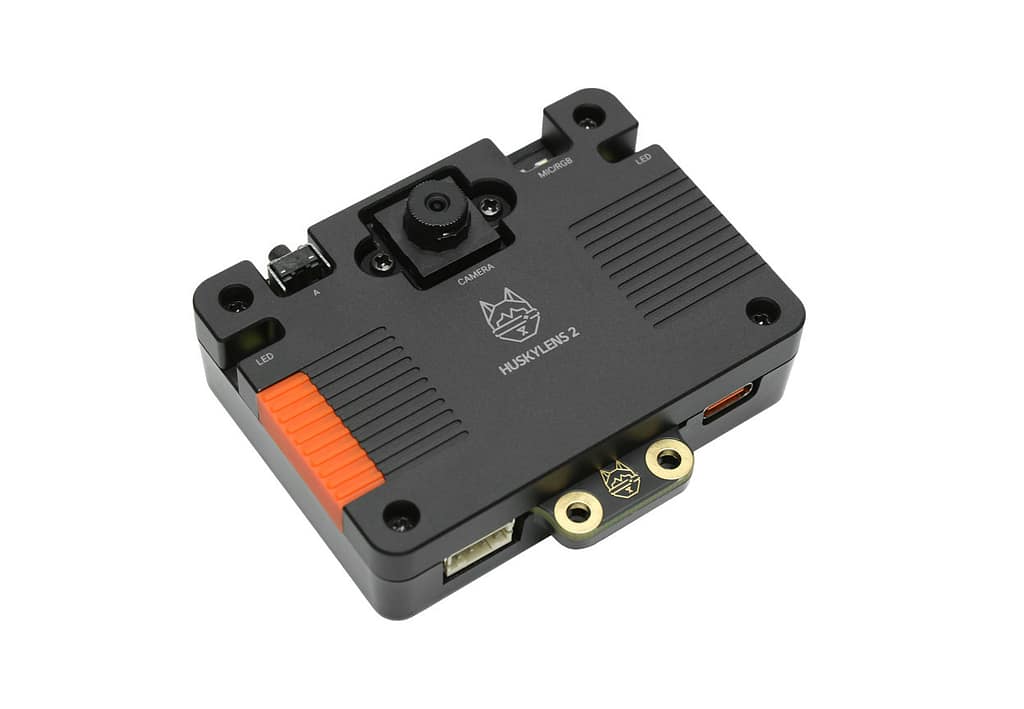
HUSKYLENS 2 is the upgraded successor to the original HUSKYLENS AI camera released in 2019. Designed for makers, educators, robotics teams, and AI enthusiasts, it delivers a far more advanced, yet beginner-friendly platform for AI vision development.
At its core lies the Kendryte K230 dual-core RISC-V SoC, integrating a 6 TOPS AI accelerator that enables impressive on-device neural network inference performance. This hardware configuration empowers the HUSKYLENS 2 to process complex visual recognition tasks — such as object detection, tracking, and segmentation — in real time while maintaining low power consumption. The result is a balanced blend of computational efficiency and energy optimization, ideal for edge AI scenarios that demand sustained operation and reliable responsiveness.
(2) Personalized AI Through On-Device Learning
Beyond hardware, HUSKYLENS 2 introduces intelligent software features that significantly lower the entry barrier for AI development. The device comes preloaded with over 20 AI models, covering a wide range of vision tasks including object tracking, gesture recognition, and instance segmentation.
For instance, in smart security, its tracking model can monitor target movements in real time. In human-computer interaction, gesture recognition enables users to control devices naturally without touch.
What truly sets it apart is its self-learning classifier, which allows users to train custom AI models directly on the device — no deep AI expertise required. By simply showing HUSKYLENS 2 a series of examples, it can learn to recognize specific objects or scenes.
This feature expands its use across multiple domains:
- Robotics: Enable robots to recognize task-specific objects and environments.
- Smart devices: Customize recognition capabilities for home automation or consumer electronics.
- STEM education: Help students intuitively grasp machine learning principles through hands-on experiments.

2. Technical Specifications and Hardware Overview
(1) Core Hardware Architecture
The robust internal design of HUSKYLENS 2 ensures high reliability and powerful computing capabilities. The key hardware specifications are shown below:
| Category | Specification |
|---|---|
| System-on-Chip (SoC) | Kendryte K230 – Dual 64-bit RISC-V processors (1.6GHz main core + 800MHz auxiliary core), supporting RVV 1.0 instruction set |
| AI Accelerator | Dedicated NPU with 6 TOPS compute performance for high-efficiency neural network inference |
| Depth Processor | 3D structured light depth sensing, max resolution 1280×800 @ 30fps |
| Video Processor | Supports H.264/H.265/JPEG/MJPEG encoding/decoding; up to 4Kp40 or 4Kp20 video streaming |
The dual-core RISC-V CPU architecture ensures smooth parallel task execution — the main core handles complex AI workloads while the secondary core manages auxiliary processes. The 6 TOPS NPU accelerates neural inference, enabling real-time object detection and image classification.
The 3D structured-light depth engine provides accurate distance and shape data for 3D perception — vital for obstacle avoidance in robotics or detailed modeling in design and digital preservation. The video engine supports multiple codecs and resolutions, ensuring compatibility with both high-definition monitoring and live-streaming applications.
(2) Storage and Interaction
HUSKYLENS 2 is equipped with 1GB LPDDR4 RAM and 8GB eMMC flash storage, with support for microSD expansion. This ensures fast data access for model execution and sufficient local storage for AI data and models.
Its 2.4-inch IPS touchscreen (640×480) offers a clear and responsive interface for selecting models, viewing results, and adjusting settings. Integrated microphone and 1W speaker enable basic voice interaction, such as executing vision tasks via voice commands or outputting feedback audibly.
The onboard 2MP GC2093 image sensor (1/2.9” format) delivers high-quality image capture. The interchangeable lens system allows flexibility — users can fit macro or microscope lenses for educational or research projects requiring fine detail observation.
(3) Connectivity and Expansion
Connectivity options are designed for versatility and maker-friendliness:
- USB 2.0 Type-C port: Supports power input, high-speed data transfer, and firmware programming.
- 4-pin Gravity expansion port: Compatible with UART/I2C communication for integration with Arduino, Raspberry Pi, or ESP32 platforms.
- Optional 2.4GHz WiFi 6 module: Enables wireless image transmission and remote control for IoT or monitoring scenarios.
These features allow HUSKYLENS 2 to serve as the “eyes” of a robot, a visual node in smart home systems, or an embedded AI camera module for edge devices.
3. Software Ecosystem and Application Scenarios
(1) Multi-Model Framework and Developer Tools
HUSKYLENS 2 supports a robust ecosystem of pre-trained AI models and development tools. The 20+ integrated models span face recognition, object detection, pose estimation, and instance segmentation, optimized for efficient local inference.
Through the Model Context Protocol (MCP), it can connect visual recognition outputs with large language models (LLMs) for enhanced semantic reasoning. For example, when identifying food items, the system can generate nutritional analysis or dietary suggestions based on recognized ingredients — illustrating how LLMs expand the practical intelligence of embedded vision systems.
For developers, the device supports custom model training based on the YOLO algorithm. Users can collect and annotate datasets to train purpose-specific models — e.g., detecting crop diseases in agriculture or automating inventory checks in retail environments.
Comprehensive code examples and wiki documentation simplify the learning curve, providing step-by-step guidance for beginners and flexibility for advanced developers seeking full customization.
(2) Versatile Real-World Applications
HUSKYLENS 2’s compact design and AI capabilities open broad applications across sectors:
- Education: Ideal for STEM and AI literacy education. Students can visually experience how AI models learn and adapt through direct experimentation.
- Industrial automation: Detect defects on production lines or classify materials in warehouses, ensuring quality control and operational efficiency.
- Consumer electronics: Integrate with smart TVs or speakers for facial recognition, gesture control, and interactive media experiences.
- Smart home and robotics: With its 70×58×19mm footprint and 1.5–3W power draw, it easily embeds into devices such as smart locks, security cameras, and service robots, adding local AI vision capabilities for autonomous navigation and perception.

4. Market Position and Purchasing Information
(1) Differentiated Advantages
Compared to other K230-based AI vision modules like CanMV-K230 or Banana Pi BPI-CanMV-K230D-Zero, HUSKYLENS 2 stands out with its all-in-one design. It integrates camera, touchscreen, storage, and interface modules into a compact enclosure, eliminating the need for external assembly and reducing project setup time.
Its preloaded, optimized AI models and unique self-learning classifier offer out-of-the-box functionality unmatched by most developer kits. The integration of MCP protocol for LLM interaction further extends its capability — enabling multimodal AI applications rarely seen in compact edge vision devices.
The intuitive touch interface simplifies configuration and testing, ensuring a smooth experience for both beginners and advanced developers.
(2) Availability and Pricing
HUSKYLENS 2 is currently available through the DFRobot official store at $74.90 USD. While not yet listed on major marketplaces like Amazon, users can monitor DFRobot’s official channels for restock updates and promotional offers.
Comprehensive technical documentation, tutorials, and code samples are provided via the official wiki, helping users quickly deploy and customize their AI vision projects.