The Olimex ESP32-C6-DevKit-Lipo is a compact, open-source development board designed specifically for IoT applications. Powered by Espressif’s ESP32-C6 SoC, it supports Wi-Fi 6, Bluetooth 5.0 LE, and IEEE 802.15.4 networking (Zigbee / Thread / Matter). It also includes native Li-ion battery support and a UEXT expansion connector, giving it both portability and strong modular extensibility.
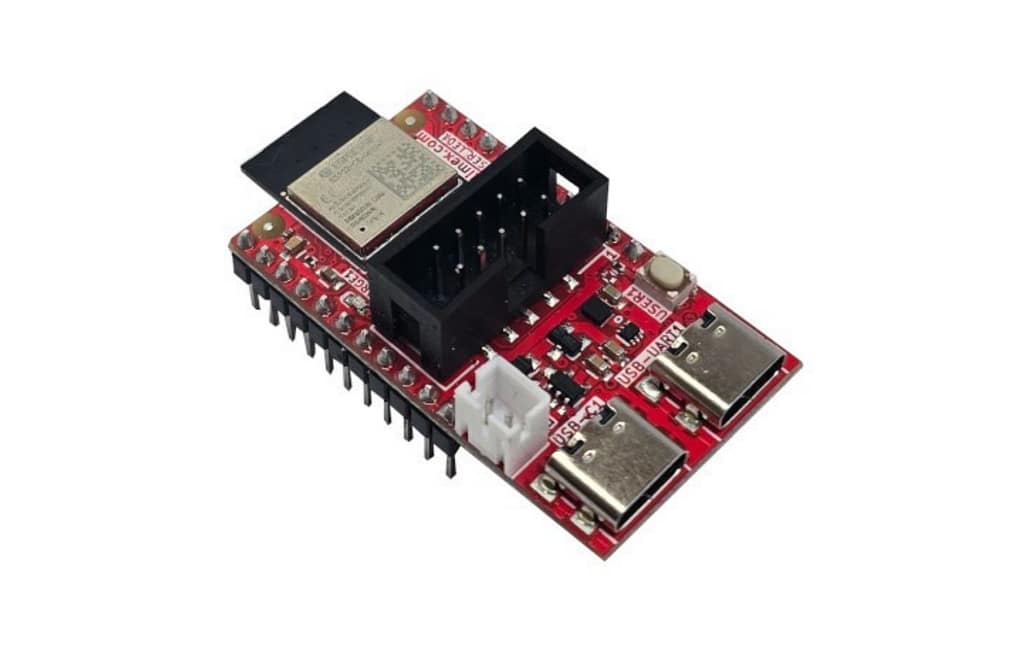
Whether you’re a maker experimenting at home, a developer building early prototypes, or a company evaluating wireless solutions, this board offers a highly practical and cost-effective starting point.
This is the second new board Olimex released this week—after the MOD-ESP32-C5—further expanding their lineup of wireless boards with UEXT interfaces. Although its 45 × 25 mm footprint is slightly larger than other ESP32-C6 breakout boards such as the 01Space ESP32-C6 or Seeed Studio XIAO ESP32C6, it compensates with an open-source design, dual USB-C ports, breadboard-friendly layout, and integrated Li-ion battery management—making it a distinctive option among small-form-factor ESP32-C6 boards.
| Category | Specifications |
|---|---|
| Core Components | ESP32-C6-WROOM-1-N4 module based on the ESP32-C6 SoC |
| CPU & Memory | Single-core 32-bit RISC-V @ 160 MHz; 512 KB SRAM + 16 KB low-power SRAM |
| Wireless Connectivity | 2.4 GHz Wi-Fi 6 (1T1R, TWT power-saving); Bluetooth 5.0 LE; IEEE 802.15.4 for Zigbee/Thread/Matter |
| Storage & Antenna | 4 MB SPI flash; onboard PCB antenna |
| USB Interfaces | Two USB-C ports: one dedicated JTAG interface; one for power + USB-Serial |
| Expansion Interfaces | 10-pin UEXT connector (GPIO, I2C, SPI, UART, 3.3V, GND); Two 11-pin headers (18 GPIO pins, 5V/3.3V power rails, 22.86 mm spacing, breadboard-friendly) |
| On-board Components | Boot button; charging indicator LED; user LED on GPIO15 |
| Power Management | 5V via USB-C; Li-ion battery input (2-pin JST); integrated UPS charging and boost converter |
| Dimensions | 45 mm × 25 mm |
| Notes | UEXT and header pins share some signals—refer to the official pinout diagrams |

Key Advantages of the Board
1. Fully Open-Source, Easy to Modify
As an open-hardware design, the board comes with complete technical resources on GitHub:
KiCad schematics (plus PDF), PCB layout, Gerber production files, STEP 3D models, and documentation.
This makes it ideal for anyone who needs to customize the hardware—whether for academic research, product prototyping, or corporate development cycles.
2. Flexible Programming Environment
The ESP32-C6-DevKit-Lipo works with:
- ESP-IDF 5.5+ (the preferred choice for professional development)
- Arduino IDE (great for beginners and rapid prototyping)
Although Olimex hasn’t yet released official example firmware for this board, the ESP32-C6 ecosystem is already well supported by community libraries and existing ESP-IDF/Arduino projects—making it easy to build IoT sensors, controllers, data loggers, and more.
3. UEXT Expansion: Plug-and-Play Modules
UEXT (Universal EXTension) is Olimex’s standardized expansion connector, and the ecosystem is large. Compatible modules include:
- Temperature/humidity sensors (e.g., MOD-TEMP2)
- Light, pressure, and environmental sensors
- LCD displays, LED matrices
- Relay boards
- RFID/NFC readers
- GPS, GSM modules
- Even biomedical boards like EKG sensors
Most modules work with simple jumper-free plug-in installation, making expansions fast and reliable.
4. Reliable Li-ion Battery Management
The integrated UPS charging and boost circuitry brings several advantages:
- Battery-only operation: ideal for outdoor monitoring, mobile robots, and remote data nodes.
- Uninterrupted power: when USB power is removed, the battery automatically takes over without resetting the system.
- Battery protection: includes over-charge and over-discharge protection to extend battery life.
This makes the board particularly useful for IoT systems deployed away from stable power sources.
5. Dual USB-C Ports: Debugging and Power Are Separate
The two USB-C connectors serve different purposes:
- Dedicated JTAG port for debugging
- Power + USB-Serial port for normal development
Unlike many compact boards that combine debugging and power into a single port, this separation prevents conflicts and makes debugging more convenient. And since USB-C cables and chargers are ubiquitous, powering the board is extremely straightforward.
Recommended Use Cases
Smart Home Prototyping
With support for Zigbee, Thread, and Matter, the board is ideal for:
- Lighting controllers
- Environmental sensors
- Door/window sensors
- Matter-compatible IoT nodes

Outdoor / Battery-Powered IoT Devices
The Li-ion battery support and UPS features make it suitable for:
- Soil moisture sensors
- Weather or environmental data collection
- Remote telemetry nodes
Education and Maker Projects
Thanks to its open hardware design and Arduino compatibility, the board is great for electronics courses, workshops, and creative prototyping.
Lightweight Industrial or Equipment Monitoring
Pair it with a UEXT industrial sensor module to quickly build systems for:
- Equipment status monitoring
- Data logging
- Remote diagnostics
Availability and Pricing
The ESP32-C6-DevKit-Lipo is available directly from the Olimex online store for €8.95, making it cost-effective for both prototyping and bulk evaluation.