In the Mini PC market, $459 has long been an awkward price point. You typically end up with either an outdated Intel N100 system or a refurbished laptop motherboard in a small box. The arrival of the PELADN WO4, powered by the AMD Ryzen 5 7640HS, changes that narrative entirely.
After hands-on testing covering hardware design, Windows and Linux performance, Proxmox virtualization, and even local AI large-model inference, it becomes clear that this compact machine hides far more potential than its price tag suggests.
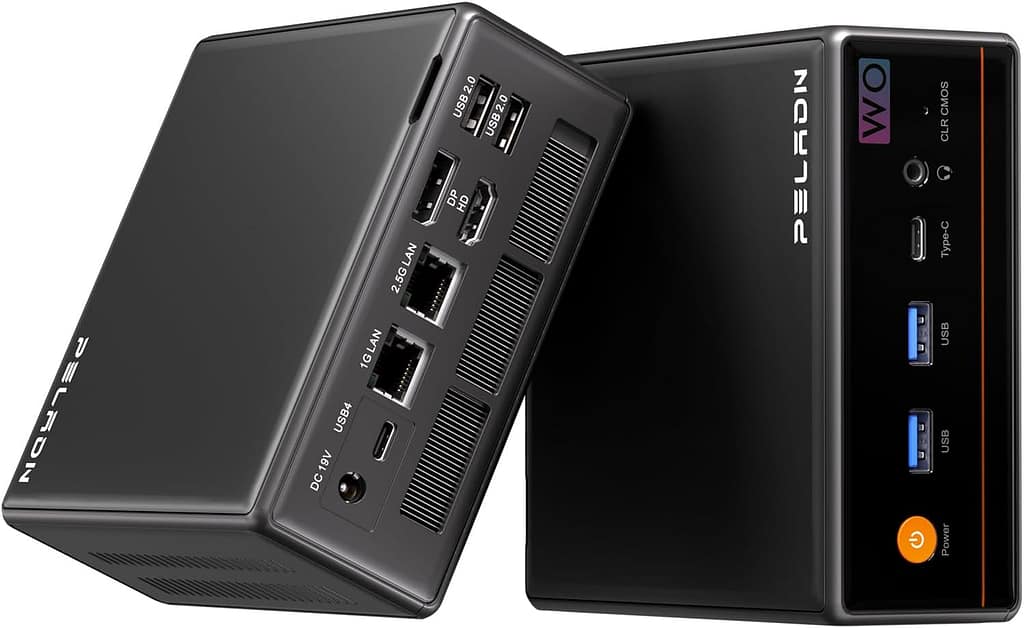
1. Hardware Overview: “Geek DNA” at the $459 Level
The first impression out of the box is how lightweight the unit feels—yet the build quality does not feel cheap.
Magnetic Tool-Free Top Cover (Standout Feature)
The magnetic top panel allows tool-less disassembly. With a simple lift, the internal layout is fully exposed. For enthusiasts who frequently upgrade memory or storage, this design is genuinely practical and rare at this price.
Internal Component Choices
- Memory: Preinstalled Crucial DDR5-5600 memory. Using a tier-one brand at this level is a pleasant surprise.
- Dual NVMe Slots: Two M.2 slots are available, and the system includes a metal heatsink with thermal pads. Under sustained ~90W load, this helps prevent SSD thermal throttling.
- Full-Spec I/O:
The rear USB4 (40Gbps) port is the centerpiece of the system. Combined with dual Ethernet (2.5G + 1G), the WO4 clearly targets more than basic office use—it is well suited for soft routing, homelab, and light server roles.

2. Compute Performance: How Much Bigger Hardware Can It Challenge?
2.1 Productivity & Content Creation (Windows)
| Benchmark | Result | Reference |
|---|---|---|
| Cinebench R23 (Multi-Core) | 709 pts | Apple M1 Max ≈ 791 pts |
While it does not surpass Apple’s M1 Max, the gap is remarkably small considering the price, power envelope, and physical size. In real-world use, 4K video editing, large Excel datasets, and multi-tab productivity workloads run smoothly.
The system feels consistently “snappy”, largely thanks to the Zen 4 single-core performance uplift, which is immediately noticeable in daily interactions.
2.2 Local AI Model Inference (DeepSeek R1)
With 32GB of RAM, the WO4 performs unexpectedly well in local AI workloads:
| Model | Inference Speed | Observation |
|---|---|---|
| DeepSeek R1 – 14B | 15.4 tokens/s | Faster than average human reading speed |
| DeepSeek R1 – 32B | ~5 tokens/s | Stable, usable for complex reasoning |

3. Gaming Performance: Where Does the Radeon 760M Top Out?
The integrated Radeon 760M iGPU performs on par with an entry-level discrete GPU.
| Game | Settings | Performance |
|---|---|---|
| Euro Truck Simulator | 1080p Medium | 60 FPS (locked) |
| Euro Truck Simulator | 1080p High | ~42 FPS |
| Euro Truck Simulator | Ultra | ~18 FPS |
Conclusion:
- Excellent for 1080p esports titles such as League of Legends, CS2, and DOTA 2 at full frame rates.
- Modern AAA titles are playable with FSR, resolution scaling, or medium-to-low graphics settings.
4. Power Consumption & Thermals: Efficiency Done Right
| Scenario | Power Draw |
|---|---|
| Windows Idle | ~19W |
| Ubuntu Idle | ~9W |
| Full Load (3DMark) | 89–90W |
At idle under Linux, power consumption drops to an impressive 9W, making 24/7 operation extremely cost-effective. Under full load, the fan becomes audible but not harsh, and the cooling system successfully manages the 54W TDP CPU without throttling.
5. Advanced Use Cases: USB4 and Virtualization
5.1 USB4 Expansion Potential
Using a 40Gbps external NVMe enclosure, testers successfully attached 16TB of high-speed storage.
This fundamentally changes the expansion story:
- External eGPU docks can transform it into a compact gaming rig.
- External NVMe arrays turn it into a capable editing or data-processing workstation.
5.2 Proxmox Virtualization Performance
Under Proxmox, the WO4 remains remarkably composed:
- Windows VM
- Ubuntu desktop VM
- Multiple Docker containers running simultaneously
Even with all workloads active, total system power draw stays between 37W and 50W, making it an excellent low-power virtualization node.
6. Final Verdict: Is It Worth Buying?
Strengths
- Zen 4 architecture with strong single-core performance
- Exceptionally AI-friendly for local LLM inference
- Fully loaded I/O: USB4, dual Ethernet, dual NVMe
- Tool-free upgrades via magnetic top cover
Weaknesses
- Glossy front panel attracts fingerprints easily
- Fan noise under sustained heavy load, inevitable given the compact form factor
Who Should Buy It?
- Students & Office Users: Replace bulky desktops with a clean, monitor-mounted setup.
- Developers & Homelab Enthusiasts: An ideal Proxmox node with low power draw and fast I/O.
- AI Hobbyists: Before investing in expensive accelerators, this is a cost-effective way to run DeepSeek locally.
Bottom line:
At $459.99, the PELADN WO4 is not a gimmick—it is one of the most balanced, forward-looking Mini PCs currently available.