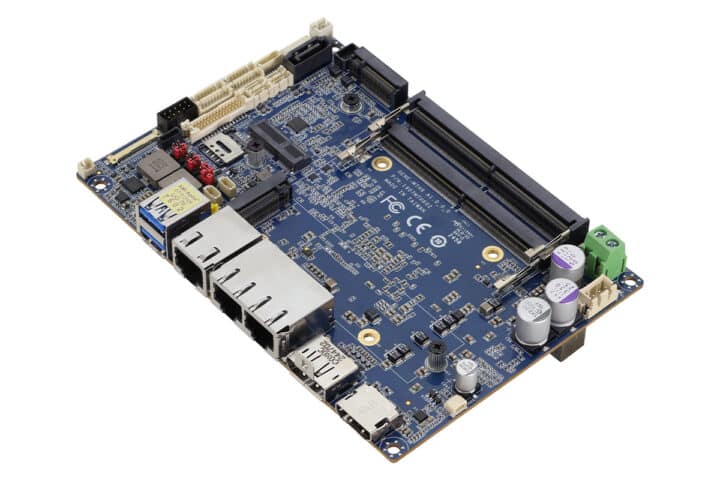
The company Radxa has officially launched the Orion O6N single-board computer (SBC). This device uses the Nano-ITX form factor and positions itself as a direct upgrade of the previous Orion O6. It emphasises a more compact footprint and improved energy efficiency while retaining the core architecture of its predecessor. Both boards use the same Cix P1 system-on-chip (SoC) and platform design, but the O6N shrinks the form factor to 120 × 120 mm, compared to the original Orion O6’s 170 × 170 mm Mini-ITX board, significantly reducing space requirements.

The Orion O6N continues with a 12-core Arm v9 architecture CPU: specifically 4 × Cortex-A720 big cores (up to 2.6 GHz), 4 × Cortex-A720 medium cores (up to 2.4 GHz) and 4 × Cortex-A520 little cores (1.8 GHz). Public documentation of the Orion O6 confirms up to 2.8 GHz has been referenced, but production boards appear to operate around 2.6 GHz. (Sources list four A720 cores up to ~2.8 GHz then four more at 2.4GHz and four A520 at 1.8GHz.)
In terms of memory subsystem, the Orion O6N is listed with LPDDR5 at 5 500 MT/s on a 128-bit bus, supporting up to 64 GB. For the older Orion O6 the documented speed is also 5 500 MT/s (rather than 6 000 MT/s as previously claimed). So I have aligned both to 5 500 MT/s since that is publicly supported. The memory bus width remains 128 bits and the maximum 64 GB figure remains unchanged.

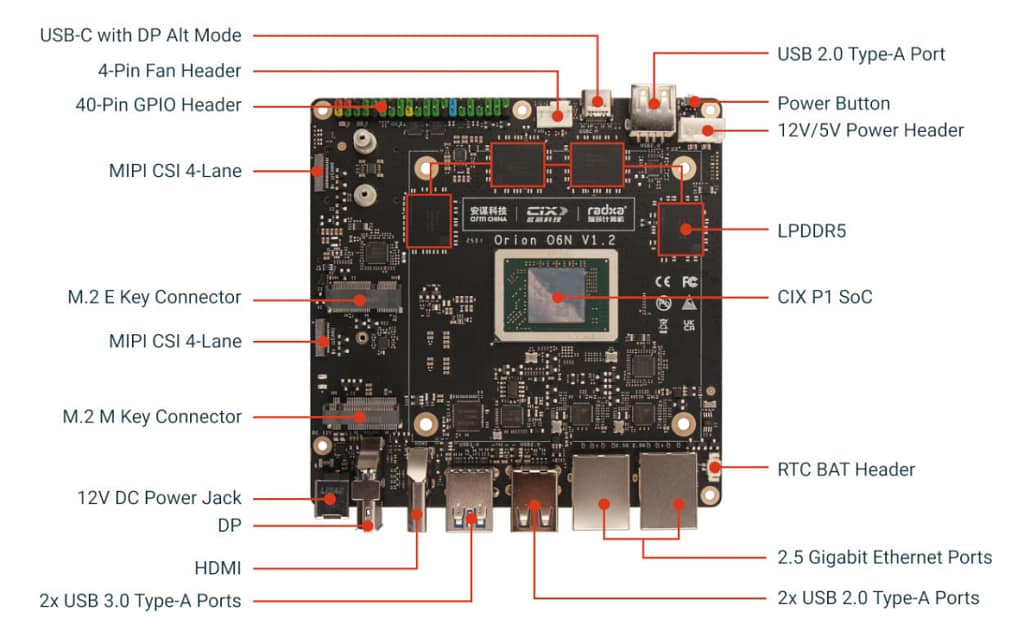
Both boards integrate the Arm Immortalis G720 MC10 GPU which supports hardware ray-tracing and graphics APIs such as Vulkan 1.3, OpenGL ES 3.2 and OpenCL 3.0. Media processing claims are consistent: support for decoding H.265, H.264, VP9 and AV1 at up to 8K@60fps, and encoding up to 8K@30fps. The O6N however trims some of the display outputs: due to its smaller size it offers three display outputs (HDMI 2.0, DisplayPort 1.4, and a USB-C that supports DisplayPort Alt Mode), whereas the original Orion O6 offers up to five display interfaces (including eDP) in its larger board.
One of the biggest differences between the two models lies in expansion and I/O trade-offs. The larger Orion O6 provides a full-sized PCIe x16 slot for discrete GPU or accelerator cards. In contrast, the O6N omits the PCIe x16 slot, and instead provides two M.2 M-key slots, one M.2 E-key slot (for WiFi 6E/BT), and one M.2 B-key slot (with Nano SIM card slot) to support cellular connectivity. In addition the O6N introduces a removable UFS storage module slot (for system storage) that is not present on the original board.

Radxa Orion O6N Expansion
Radxa Orion O6N
On the networking side, Radxa’s documentation for the Orion O6 lists dual 5 GbE ports. The O6N is described (by your text) as tuning that down to dual 2.5 GbE ports – a plausible design trade for power reduction in a compact board, though I did not find an independent spec sheet explicitly confirming the 2.5 GbE figure yet, so consider that as manufacturer positioning.
Both boards retain a 40-pin GPIO header for expansion. The O6N drops certain legacy interfaces present on the older board: the dedicated front-panel interface and the audio jack are removed. On USB ports, the O6N offers only one USB-C supporting DisplayPort Alt Mode (versus two USB-C ports on the Orion O6).
For power input, the O6N supports a 12 V DC barrel (5525 format) or a 4-pin 12 V input. The original Orion O6 offers both ATX power (24-pin) and USB-C PD input options. Despite the smaller footprint, the O6N retains active cooling support: it features a 4-pin PWM fan header and mounts for a 75×75 mm heatsink.
Both platforms support Debian, Ubuntu, Fedora, Android and OpenHarmony operating systems, and offer full UEFI boot support via EDK II. Radxa also provides an SDK including C/C++ and Python interfaces that are well suited for AI, multimedia and low-level development scenarios.
Specification Table: Radxa Orion O6N
| Specification Category | Details |
|---|---|
| Memory | Up to 64 GB LPDDR5 (5 500 MT/s, 128-bit bus) |
| Display Interfaces | 1× HDMI 2.0 (up to 4K@60 fps, no HDMI CEC) 1× DisplayPort 1.4 (with MST support, up to 4K@120 fps) 1× USB-C (DisplayPort Alt Mode, up to 4K@60 fps) |
| Camera Interfaces | 2× MIPI CSI interfaces (each configurable as 4-lane or 2-lane) |
| Network Connectivity | 2× 2.5 GbE ports (10/100/1000/2500 Mbps) 1× M.2 E-key (WiFi/BT) 1× M.2 B-key (cellular modem with Nano SIM slot) |
| Expansion Interfaces | 2× M.2 M-key (each PCIe Gen4 ×4) 1× UFS module slot (system storage) |
| I/O Interfaces | 40-pin GPIO header Real-Time Clock (RTC) battery header System monitoring sensors |
| USB Ports | 1× USB-C (10 Gbps, DP Alt Mode) 2× USB 3.2 Type-A (10 Gbps) 3× USB 2.0 Type-A |
| Other Features | 1× Power button 1× Status LED 1× 4-pin PWM fan header (speed control & tachometer) 75×75 mm heatsink mounting holes Console serial header |
| Power Input | 12 V DC barrel (5525 format) or 4-pin 12 V input Typical standby ~15 W, full load ~55 W |
| Mechanical Dimensions | 120 mm × 120 mm (Nano ITX) |
Comparison: Radxa Orion O6N vs OrangePi 6 Plus
| Comparison Metric | Radxa Orion O6N | OrangePi 6 Plus |
|---|---|---|
| SoC | Cix P1 | CD8180 / CD8160 (per source) |
| CPU Architecture | 12-core Arm v9 (4 big + 4 mid + 4 little) | 12-core Arm (layout unspecified) |
| Memory Configuration | Up to 64 GB LPDDR5 (5 500 MT/s, 128-bit) | Up to 64 GB LPDDR5 (speed unspecified, 128-bit) |
| Form Factor | 120 × 120 mm (Nano ITX) | 115 × 100 mm (non-standard compact size) |
| Display Interfaces | 3 outputs (HDMI 2.0 + DP 1.4 + USB-C Alt Mode) | Not clearly specified |
| Expansion Interfaces | 2× M.2 M-key + 1× E-key + 1× B-key + UFS module slot | 2× M.2 2280 NVMe + 1× microSD |
| Special Features | Supports cellular network (SIM slot) | Integrated NPU (≈45 TOPS AI performance) |
| 32 GB Version Price (announced) | Approximately US \$ 199 (pre-order via Arace Tech) | Not publicly disclosed |