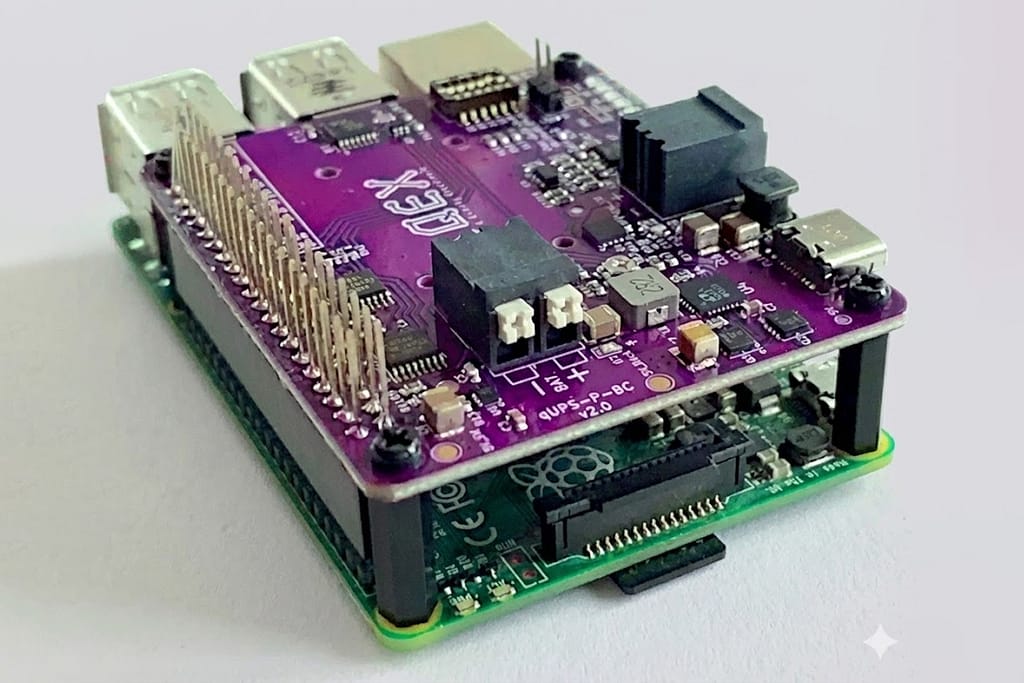
If you need a UPS HAT that provides long-duration backup power, handles a wide range of battery chemistries, and delivers stable output during unexpected outages, the qUPS-P-BC-2.0 from AQEX (Hungary) is engineered precisely for that purpose. It combines broad battery compatibility, high-capacity support, and robust electrical protection—ideal for mission-critical Raspberry Pi deployments.
Key Advantages for Raspberry Pi Users
Designed for Raspberry Pi 5, 4B, 3B+, and any board with a standard 40-pin header, the qUPS-P-BC-2.0 supports an unusually wide range of battery types. It works with Li-Ion, LiFePO₄, and the increasingly popular Sodium-Ion cells, and it even supports large prismatic packs up to 300 Ah—far beyond the limits of conventional UPS HATs.
This makes it suitable for:
- Remote monitoring stations
- Edge-computing nodes
- Home servers
- Industrial controllers
- Solar-powered Raspberry Pi systems
When extended runtime and battery flexibility are essential, this HAT stands out.
Power Architecture and Performance
The qUPS-P-BC-2.0 uses an offline UPS topology with a high-efficiency boost converter, achieving a switchover time under 1 ms, preventing system glitches during grid or adaptor failures.
It supports dual input sources—USB-C and screw terminals—with automatic, ultra-fast switchover. An adjustable input voltage threshold (via potentiometer) lets engineers tune behavior for different power systems.
Power Input Specifications
| Parameter | Value |
|---|---|
| USB-C Input | 5.0–5.2 V (USB PD compatible on Pi 5) |
| Screw Terminal Input | 5.2–28 V |
| Switchover Time | 100–300 µs (input-to-battery or battery-to-input) |
| Input Voltage Threshold | Adjustable via onboard potentiometer |
Power Output Specifications
| Parameter | Value |
|---|---|
| Output Voltage | 5 V via 40-pin GPIO header |
| Continuous Load Current | Up to 3.5 A |
| Peak Discharge Current | Up to 7.5 A |
Battery & Charging Specifications
| Parameter | Value |
|---|---|
| Supported Chemistries | Li-Ion, LiFePO₄, Sodium-Ion |
| Supported Capacities | Up to 300 Ah |
| Charging Current | 1 A or 2 A (selectable via DIP switch) |
| Protection | Thermal, reverse-polarity, chemistry-aware cutoff |
| Cutoff Voltage (AUTO) | 3.1 V |
| Cutoff Voltage (ON) | 2.5 V |
Intelligent Protection and Practical Design
Safety and predictability are central to qUPS-P-BC-2.0’s design:
- Reverse-polarity protection
- Temperature protection (optional NTC; pins must be shorted if unused)
- Hardware-level cutoff to avoid reboot loops
- Three-position mode switch (OFF / ON / AUTO) for safe startup behavior
AUTO mode ensures the system only boots if sufficient charge is available and powers down automatically when battery levels can no longer sustain the load.
The board also exposes three GPIO-selectable communication lines for:
- Power-loss alerts
- Low-battery warnings
- Safe-shutdown triggers
A five-segment LED bar (LOW, SAFE, MIN, HALF, MAX) provides intuitive battery-level feedback, and dedicated indicators show input status and reverse-polarity conditions.
Physical & Mechanical Details
| Parameter | Value |
|---|---|
| Form Factor | Standard Raspberry Pi HAT |
| Dimensions | 65 × 56 × 23 mm (plus 11 mm header) |
| Header | Pre-soldered 40-pin connector |
| Mounting Options | 6× M2 screw holes; optional 3D battery holder (STL available) |
The stacked header allows integration with additional HATs—useful for sensor modules, network adapters, or solar-power controllers.
Software Integration and Setup
Software support is intentionally lightweight, relying mainly on hardware DIP switches for configuration. Raspberry Pi integration is available via GitHub in both C++ and Python, enabling:
- Battery/UPS status monitoring
- Power-loss detection
- Automated safe shutdown
- System-level notifications
This approach keeps the UPS highly reliable and easy to adopt in embedded or industrial systems where minimal software dependencies are preferred.
Real-World Backup Performance
With a 4,000 mAh LiFePO₄ or Li-Ion battery, testing shows the qUPS-P-BC-2.0 can keep a Raspberry Pi 4 running more than seven hours at idle. Even Sodium-Ion cells around 3,500 mAh deliver practical runtime for shorter outages.
Under full computational load, the HAT still provides sufficient buffer time for:
- Graceful shutdown
- Data flush
- Protection of storage media
This resilience is critical for servers, logging systems, and remote deployments.


Why Choose qUPS-P-BC-2.0 Over Competitors?
Most UPS HATs such as the Waveshare UPS HAT (E), PiJuice Zero, or PiVoyager rely on compact Li-Po pouches or supercapacitors. These solutions offer convenience but are limited in runtime and capacity.
In contrast, AQEX’s qUPS-P-BC-2.0 provides:
- Multi-chemistry support
- Massive battery capacity (up to 300 Ah)
- Fast, seamless switchover
- Industrial-grade protection features
For solar-powered systems—especially when paired with dedicated solar interfaces such as PV-PI modules—or for applications requiring long autonomous operation, this HAT provides superior adaptability.
Availability
The AQEX qUPS-P-BC-2.0 is available exclusively on Tindie for $62.00.
The product page includes extended runtime measurements, detailed specifications, software resources, and mechanical design files to help you integrate it into your next Raspberry Pi project.