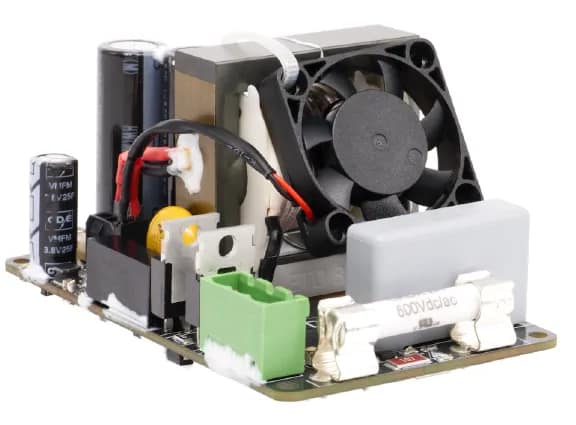
Looking for a compact, energy-efficient, and reliable power conversion solution for high-voltage systems? The electrically isolated, credit-card-sized DC/DC converter DCDCv9-3 is purpose-built for efficient high-voltage to low-voltage conversion. It is well suited for automotive platforms, laboratory environments, and industrial test systems, standing out through its strong performance, high efficiency, and flexible configuration options.

Designed specifically for high-voltage conversion, the DCDCv9-3 supports a wide input voltage range from 200 V to 600 V DC. Output power capability scales with input voltage, enabling reliable operation across diverse load profiles:
| Input Voltage | Maximum Output Power | Operating Mode |
|---|---|---|
| 400–600 V | 750 W | Peak (60 s) |
| 400–600 V | 600 W | Peak (180 s) |
| 400–600 V | 500 W | Continuous |
| 300 V | 500 W | Maximum |
| 200 V | 300 W | Maximum |
The standard output voltage is 24 V DC, with configurable options from 12 V to 48 V, allowing the converter to adapt to a wide range of system requirements.
In terms of form factor, the converter offers a clear advantage in space-constrained designs. With dimensions of 85.6 × 54 mm—comparable to a credit card—and a weight of just 167 g, it can be easily integrated into compact enclosures or densely packed systems.
High Efficiency and Low Power Loss
Efficiency is a defining strength of the DCDCv9-3. The design operates over a 90 kHz to 200 kHz variable switching frequency and employs a resonant LLC soft-switching topology combined with an active rectification stage. Under a typical operating condition of 500 V input and 500 W output, the converter achieves a peak efficiency of 96.9%, significantly reducing thermal stress and energy loss.
Standby and light-load performance are equally optimized. No-load power consumption is limited to 7–9 W, and at 600 V input, the standby leakage current is as low as 75 nA, helping minimize long-term energy waste in always-on systems.
The power stage is controlled by a cost-effective LLC controller, paired with an isolated gate driver offering 4 A / 6 A source-sink capability. A self-charging startup capacitor and an electrically isolated enable pin further enhance operational stability and system robustness.
Safety and reliability are built into the design. The DCDCv9-3 integrates multiple protection mechanisms, including:
- Input undervoltage protection
- Input overvoltage protection
- Output overcurrent protection
- Solid-state pre-charge circuitry to limit inrush current and prevent component stress
From an electrical safety perspective, the converter maintains a minimum clearance of 4.5 mm, meeting EV safety requirements for 600 V DC systems with conformal coating. The design complies with FSG-Rules 2025, ensuring suitability for demanding automotive and industrial environments.
An optional rear-side PCB-mounted connector is available, providing additional flexibility for mechanical integration and system assembly.

Application Scenarios
- Automotive systems: Designed for electric vehicles with 400 V or 600 V battery architectures, the converter provides stable low-voltage power for onboard electronics and auxiliary subsystems.
- Laboratory and industrial testing: Functions effectively as a constant-voltage (CV) bench power supply, delivering reliable power for test equipment, prototypes, and industrial measurement setups.
For engineers interested in the internal design, detailed resources are available, including schematics, PCB layouts, 3D models, and the complete BOM. Component properties, routing details, and pad definitions can be explored interactively, and AI-assisted schematic navigation helps accelerate design understanding and reuse.
To access these materials:
https://github.com/Rootthecause/DCDC
This repository provides a comprehensive and practical reference for high-voltage, high-efficiency DC/DC converter design.