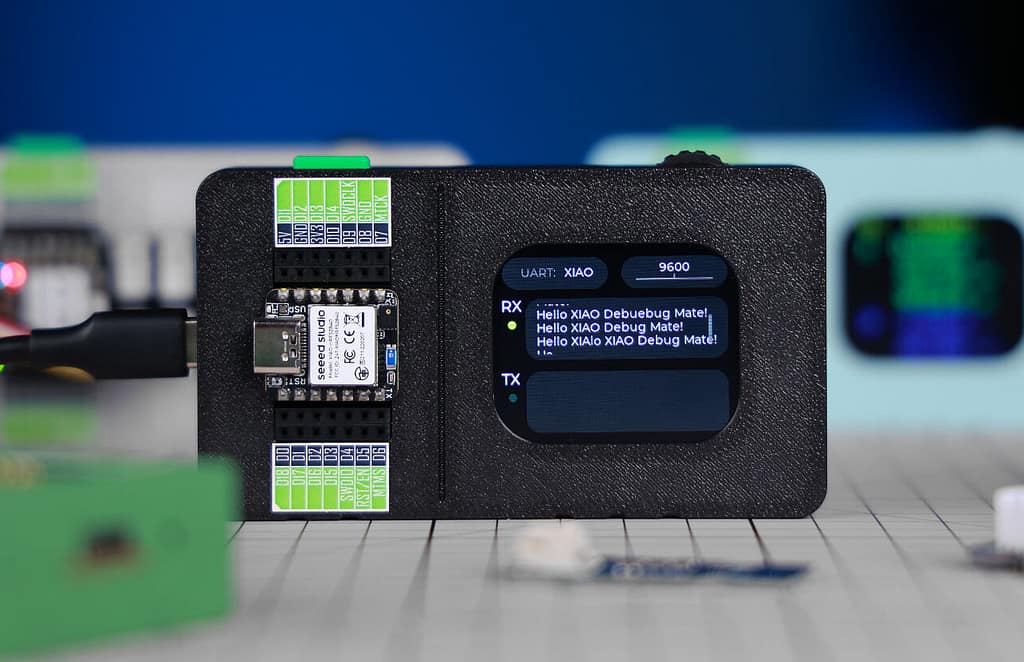
The XIAO Debug Mate from Seeed Studio is a versatile, low-cost debugging and monitoring tool built around the ESP32-S3 platform. Designed primarily for the XIAO USB-C series development boards, it integrates three essential functions for embedded engineers: a DAPLink debugger, a serial monitor, and a high-accuracy power analyzer. While optimized for the XIAO ecosystem, its UART monitoring capability also supports third-party boards such as Arduino and Raspberry Pi, making it a practical utility across a wide range of development workflows.
| Category | Specification |
|---|---|
| Wireless MCU | Espressif ESP32-S3R8 |
| CPU | Dual-core Tensilica LX7 @ 240 MHz |
| Memory Configuration | 512 KB SRAM + 8 MB PSRAM + 8 MB SPI Flash |
| Wireless Connectivity | Wi-Fi 4, Bluetooth 5.0 (Classic + BLE) |
| Display | 2.01-inch TFT LCD, 296 × 240 px |
| Expansion Interfaces | - 2× 14-pin female GPIO headers (XIAO pin breakout) - 2× 14-pin male GPIO headers (bottom side) - 8× pogo-pin GPIO pads (compatibility varies by XIAO model) - UART Grove connector |
| Debugging Support | DAPLink, OpenOCD Compatible with: SAMD21, nRF52840 (Sense), RP2040, RP2350, RA4M1, MG24 (Sense) Not supported: XIAO nRF54L15, ESP32 (C3/S3/C6) models due to pin mismatches |
| Controls & Indicators | - Recessed reset button + green user button - Scroll wheel menu navigation - 36-LED matrix (bottom; factory firmware uses it for baud-rate indication) |
| Power Input | USB-C, 5V / 1A |
| Physical Dimensions | 100 × 56 × 20 mm |
| Enclosure | Black PLA 3D-printed shell |


Bottom and two sides with I/O headers, baudrate LED matrix, USB-C port, green button, and scroll wheel
Core Functional Modules
1. DAPLink Debugger for Arm Cortex-M Targets
The XIAO Debug Mate provides full DAPLink functionality with support for OpenOCD and PyOCD. Engineers can perform:
- Breakpoint configuration
- Single-step execution
- Memory inspection
- Low-level hardware control
Through its SWD interface, the debugger works with most Arm Cortex-M based boards including the XIAO SAMD21, RP2040 series, and several mainstream MCUs.
Note: ESP32-based XIAO boards and the nRF54L15 series are not supported due to architectural and pin-mapping differences.

2. Serial Monitor & UART Passthrough
This module functions as a dual-role serial interface supporting both monitoring and data forwarding:
Bidirectional Data Capture
It can monitor communication between:
- A XIAO USB-C board and the Debug Mate
- The Debug Mate and external UART peripherals such as Arduino controllers, Raspberry Pi boards, or Grove sensors
Data Visualization
- Real-time UART data is displayed directly on the built-in screen.
- Data can also be forwarded to a PC for advanced analysis.
Broad Compatibility
The device can operate independently as a USB-to-TTL serial adapter, providing a convenient debugging interface for non-XIAO hardware.
3. High-Accuracy Power Analysis
The integrated power analyzer is designed for developers working on low-power applications:
- Microamp-level measurement: Tracks current consumption down to the μA range
- Voltage/current readouts: Displays real-time electrical metrics
- Peak/valley detection: Automatically identifies power-usage spikes and dips
- Accuracy: ±10% within the 1–10 μA measurement range
This makes it suitable for profiling sleep modes, optimizing wake-up behavior, and validating low-energy designs.

Although it may appear to be a universal 3-in-1 debugger, the XIAO Debug Mate is optimized specifically for Seeed Studio’s XIAO USB-C series (except certain ESP32 variants).
For third-party platforms like Arduino or Raspberry Pi, its value lies mainly in the UART monitoring and serial debugging capabilities.
Seeed Studio provides a comprehensive getting-started guide on its official wiki, enabling rapid deployment for both beginners and experienced developers.
The device is affordably priced at USD 19.90, and is available through AliExpress or the Seeed Studio official store.